
For leak detection contractors working in dense urban environments, the gap between detection and confirmation is where programs break down. Mobile surveys flag indications. Field teams go investigate. And too often, they come back empty-handed — burning time, adding risk, and leaving confidence in the program low.
That’s exactly where AGD found itself before deploying Project Canary’s integrated detection platform across its utility operations.
Problem: Investigating Indications from Advanced Mobile Leak Detection (AMLD)
AGD provides leak detection and survey services to utilities across the country, including a large multi-state utility with more than 60,000 miles of distribution main.
The challenge wasn’t mobile detection — it was what came after. Advanced mobile leak detection surveys were surfacing indications in challenging urban environments: dense pavement, business districts, difficult subsurface conditions. Traditional handheld equipment couldn’t follow up with enough precision. Teams were missing leaks, spending hours on manual probing with little direction, and returning with low confidence in their results.
The tools weren’t keeping up with the data the surveys were generating.
The Solution: PICO + RECON AMLD + SENSE Utilities
AGD turned to Project Canary’s full detection stack to close that gap.
The starting point was PICO, Project Canary’s handheld investigation device. PICO operates at parts-per-billion sensitivity — well below the threshold of standard CGI and FID instruments used in most field crews today — and includes an integrated pump designed to draw air from cracks in concrete and other hard surfaces. Its ethane discrimination capability separates true pipeline leaks from biogenic methane sources, a distinction that matters significantly in dense urban environments where background methane from organic sources is common. Field teams get a clear, confident signal rather than an ambiguous reading they have to chase.
AGD and the utility put PICO through rigorous field testing before approving it for investigations — a standard but critical milestone in utility operations. It passed.
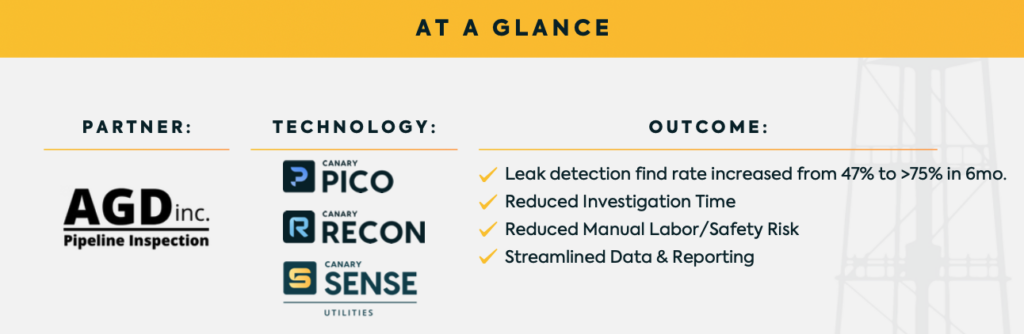
From there, AGD expanded the deployment. They integrated Project Canary’s RECON AMLD for mobile surveys and brought in the SENSE Utilities software platform to connect all of it.
What Makes the Difference: A Closer Look at Project Canary’s Technology
Elite sensitivity. PICO detects methane at parts-per-billion levels — roughly 1,000x more sensitive than standard field instruments. In environments where leaks are small, diffuse, or obscured by pavement, that sensitivity gap determines whether an indication gets resolved or abandoned.
Ethane discrimination. Not every methane reading is a pipeline leak. PICO distinguishes between biogenic methane — naturally occurring in soil and organic material — and thermogenic gas from a true pipeline leak. That distinction eliminates false investigative dead-ends and gives field crews confidence in what they’re actually finding.
Pump-enabled performance. The integrated pump draws air directly from cracks in concrete and other hard surfaces, allowing PICO to detect leaks in the dense, high-pavement environments where traditional handheld equipment falls short.
Field-tested and utility-approved. Before deployment, AGD and the large multi-state utility ran PICO through rigorous field evaluation. It cleared the utility’s approval process for investigations — a non-trivial standard that validates real-world performance, not just lab specs.
Integrated platform. PICO doesn’t operate in isolation. Handheld investigation data and RECON mobile survey data feed into a single system through SENSE Utilities, eliminating the manual stitching between tools that slows most field operations down.
Continuous improvement. Field feedback from AGD and other operators directly informs ongoing development — both hardware and software. The platform teams use in the field today reflects what crews have surfaced as friction points over time.
SENSE gave the team a single place to view survey paths, track measurements, and generate reports — without manual data stitching between systems. The result was a fully integrated workflow: RECON identifies potential leak locations, PICO investigates with precision, and SENSE captures, organizes, and reports everything.
The Results: Higher Leak Find Rates and a Closed Leak Detection-to-Repair Loop
The impact showed up quickly and in the metrics that matter.
Leak detection find rate increased from 47% to over 75% in under six months — a gain driven largely by PICO’s performance in the high-pavement, high-density environments where prior tools consistently underperformed.
Investigation time per indication dropped by 50%. Field teams moved faster, with more confidence, because they were working from better data and with equipment built for the conditions they were in.
Operations became safer. Reporting became simpler. And the program as a whole became more defensible — with all leak data captured and auditable in a single system.

Beyond the individual performance gains, the bigger outcome was integration. Disconnected tools create disconnected programs. When PICO, RECON, and SENSE operate as a unified system, data flows from the field into reporting without gaps, guesswork, or manual work — closing the detection-to-repair loop that most programs struggle to document end-to-end.
What This Means for Utility Leak Management Programs
The AGD deployment illustrates something the utility operations community has recognized for a while: AMLD surveys are only as valuable as the investigation process that follows them. Detection without confident follow-up just moves the problem downstream.
PICO was purpose-built for the investigation side of that loop. Combined with RECON for detection and SENSE for program management, it gives utilities and their service providers a complete, integrated path from survey to resolution. For programs still running disconnected tools across detection, investigation, and reporting, the workflow gap is where program defensibility breaks down.
—-
Contact Project Canary here to learn how the Canary PICO ppb handheld and Canary SENSE software can optimize your leak detection program.